
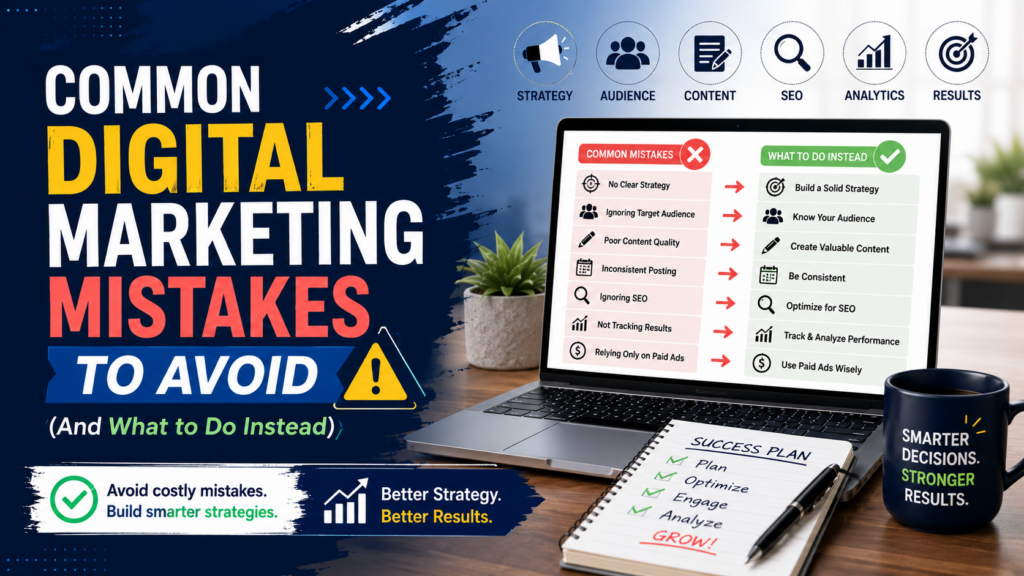
Digital marketing looks simple from the outside: post content, run some ads, watch the sales roll in. In reality, most businesses from scrappy startups to established brands waste significant budget and time on avoidable mistakes. Studies on digital ad spend consistently show that a meaningful share of marketing budgets is wasted on poorly targeted campaigns, unoptimized pages, and strategies with no clear measurement plan behind them. Understanding these pitfalls before you fall into them can save you months of frustration and thousands of dollars in wasted ad spend.
This guide walks through the most common digital marketing mistakes businesses make, digs into why they happen, and lays out exactly how to fix or avoid them with practical, actionable steps for each one.
Table of Contents
- Not Defining Clear Goals and KPIs
- Ignoring Your Target Audience
- Neglecting SEO Fundamentals
- Inconsistent Branding Across Channels
- Treating Content Marketing as an Afterthought
- Overlooking Mobile Optimization
- Underestimating the Power of Email Marketing
- Spreading Yourself Too Thin Across Platforms
- Ignoring Data and Analytics
- Running Ads Without a Strategy
- Forgetting About Customer Retention
- Not Adapting to Algorithm and Market Changes
1. Not Defining Clear Goals and KPIs
One of the most fundamental mistakes businesses make is diving into digital marketing without a clear destination in mind. “We want more traffic” or “we want to grow our brand” are not goals — they’re vague hopes. Without specific, measurable objectives, it’s impossible to know whether your campaigns are working or wasting money.
This mistake tends to compound over time. A team without clear KPIs can’t tell the difference between a campaign that’s underperforming and one that simply hasn’t been measured properly. Budget gets allocated based on gut feeling rather than evidence, and by the time leadership asks “what did we get for this spend?” there’s no good answer.
Why it happens: Marketing often gets treated as a checkbox activity “we need a website, we need social media, we need ads” rather than a strategic function tied to business outcomes. In many small businesses, marketing is handled part-time by someone wearing five other hats, and strategic planning gets skipped in favor of just “getting something out there.”
How to fix it:
- Set SMART goals (Specific, Measurable, Achievable, Relevant, Time-bound). Instead of “increase traffic,” aim for “increase organic traffic by 25% in six months.”
- Define your Key Performance Indicators (KPIs) upfront conversion rate, cost per acquisition, customer lifetime value, email open rates, etc.
- Align every campaign with a business objective: awareness, lead generation, sales, or retention.
- Separate leading indicators (traffic, engagement, click-through rate) from lagging indicators (revenue, retention) so you can course-correct early rather than only finding out at quarter’s end.
- Revisit your goals quarterly. A goal set a year ago may no longer reflect where the business is today.
2. Ignoring Your Target Audience
Many businesses market to “everyone” because they’re afraid of narrowing their reach. This backfires. Generic messaging speaks to no one in particular, and generic campaigns produce mediocre results across the board. A message crafted for a specific, well-understood audience will almost always outperform a broad, watered-down one even though it feels riskier on paper.
Why it happens: Fear of missing out on potential customers leads businesses to broaden their messaging so much that it loses all persuasive power. There’s also a common misconception that narrowing your audience means shrinking your market, when in reality it usually means speaking more effectively to the people most likely to buy.
How to fix it:
- Build detailed buyer personas based on real customer data demographics, pain points, buying behavior, and preferred platforms.
- Use tools like Google Analytics, social media insights, and customer surveys to understand who’s actually engaging with your brand.
- Tailor messaging, tone, and offers to specific audience segments rather than using one-size-fits-all content.
- Map out the customer journey for each persona what triggers awareness, what objections come up before purchase, and what convinces them to buy.
- Talk to actual customers periodically. Surveys and analytics tell you what people do; direct conversations tell you why.
3. Neglecting SEO Fundamentals
Search Engine Optimization is a long-term investment, and it’s often the first thing businesses skip because results aren’t instant. But ignoring SEO means leaving free, high-intent traffic on the table indefinitely traffic that, unlike paid ads, keeps working for you long after the content is published.
Common SEO mistakes include:
- Keyword stuffing or, conversely, not researching keywords at all
- Ignoring technical SEO slow page speed, broken links, missing alt text, poor site structure
- Not optimizing for search intent (informational vs. transactional queries)
- Failing to build quality backlinks
- Duplicate content or thin content that provides little value
- Ignoring local SEO (Google Business Profile, local citations, location-based keywords)
- Neglecting structured data/schema markup, which helps search engines understand and showcase your content in rich results
- Focusing only on head keywords while ignoring long-tail keywords that convert at a much higher rate
How to fix it:
- Conduct thorough keyword research using tools like Google Keyword Planner, Ahrefs, or SEMrush, and prioritize a mix of high-volume and long-tail terms.
- Optimize on-page elements: title tags, meta descriptions, header structure, and internal linking.
- Regularly audit your site for technical issues using tools like Google Search Console crawl errors, slow-loading pages, and mobile usability problems all hurt rankings.
- Create content that genuinely answers user questions rather than content built purely to rank; search engines increasingly reward depth and usefulness over keyword density.
- Build backlinks through guest posting, partnerships, digital PR, and creating genuinely link-worthy content like original research or in-depth guides.
- Claim and fully optimize your Google Business Profile if you serve local customers it’s often the single highest-leverage local SEO action available.
4. Inconsistent Branding Across Channels
If your Instagram feels playful, your website feels corporate, and your email newsletter feels random, customers notice even if only subconsciously. Inconsistent branding erodes trust and makes your business look unprofessional or unreliable. Consistency, on the other hand, compounds: the more often someone sees a recognizable, coherent brand, the more credible and memorable it becomes.
How to fix it:
- Create brand guidelines covering tone of voice, color palette, typography, logo usage, and imagery style.
- Make sure every team member or agency working on your marketing has access to these guidelines, and build them into onboarding for new hires or contractors.
- Audit all your channels periodically to ensure consistency website, social media, email, ads, and offline materials.
- Extend consistency to customer-facing language, not just visuals the way you answer support tickets should sound like the same brand as your homepage copy.
- Update your guidelines as the brand evolves, but roll out changes deliberately across all channels at once rather than piecemeal.
5. Treating Content Marketing as an Afterthought
Many businesses publish content sporadically, with no strategy behind topic selection, format, or distribution. This results in a content library that doesn’t build authority, doesn’t rank well, and doesn’t convert. Content marketing rewards consistency and depth far more than volume a handful of genuinely excellent, well-promoted pieces will typically outperform dozens of thin, rushed ones.
Common mistakes:
- Publishing inconsistently (a burst of posts, then silence for months)
- Creating content without researching what the audience actually wants
- Focusing purely on promotional content instead of providing value
- Not repurposing content across formats (blog to video, video to social clips, etc.)
- Publishing content with no distribution plan, assuming it will simply be found
How to fix it:
- Build a content calendar aligned with your audience’s needs and your sales funnel stages awareness content at the top, comparison and evaluation content in the middle, and conversion-focused content near the bottom.
- Focus on quality and usefulness over quantity one excellent, in-depth article outperforms ten shallow ones.
- Repurpose high-performing content into multiple formats to maximize ROI on content creation (a long blog post can become a video script, a carousel, an email series, and several social posts).
- Track content performance and double down on what resonates, retiring or updating what doesn’t.
- Treat promotion as part of the content process, not an afterthought plan how each piece will be distributed before you publish it.
6. Overlooking Mobile Optimization
More than half of global web traffic comes from mobile devices, yet many businesses still design primarily for desktop and treat mobile as secondary. A clunky mobile experience tiny text, awkward forms, slow load times drives visitors away almost instantly, and search engines also factor mobile experience into rankings.
How to fix it:
- Use responsive design so your website adapts seamlessly to any screen size, rather than a stripped-down “mobile version” that feels like an afterthought.
- Test page load speed on mobile specifically mobile users are especially impatient with slow sites, and every extra second of load time measurably increases bounce rates.
- Simplify navigation and forms for smaller screens; long forms with many fields are a major mobile conversion killer.
- Ensure buttons, fonts, and images are appropriately sized for touch interaction, with enough spacing to avoid accidental taps.
- Test checkout and lead-capture flows specifically on mobile devices this is where friction costs you the most revenue.
7. Underestimating the Power of Email Marketing
Many businesses treat email as outdated in favor of social media, but email consistently delivers one of the highest returns on investment among digital marketing channels largely because it’s a channel you own, not one governed by an algorithm you don’t control. Ignoring it, or doing it poorly, means missing a highly effective way to nurture leads and retain customers.
Common mistakes:
- Not segmenting email lists, resulting in irrelevant messaging
- Sending purely promotional emails with no value-driven content
- Neglecting subject line optimization, leading to poor open rates
- Failing to automate welcome sequences, abandoned cart emails, or re-engagement campaigns
- Ignoring list hygiene, which hurts deliverability and inflates unengaged subscriber counts
How to fix it:
- Segment your list based on behavior, interests, or purchase history so subscribers receive relevant messaging rather than generic blasts.
- Mix promotional emails with educational or entertaining content to keep subscribers engaged rather than treating your list as a purely sales channel.
- A/B test subject lines and send times to improve open and click-through rates.
- Set up automated email flows for onboarding, nurturing, and win-back campaigns these often outperform one-off campaigns because they’re triggered at the moment of highest relevance.
- Regularly clean your list of unengaged subscribers to protect your sender reputation and deliverability.
8. Spreading Yourself Too Thin Across Platforms
Trying to maintain an active, high-quality presence on every social platform simultaneously is a recipe for burnout and mediocrity. Not every platform is right for every business, and spreading limited time and budget across too many channels usually means doing all of them poorly rather than a few of them well.
How to fix it:
- Identify where your target audience actually spends time, and focus your energy there rather than chasing every trending platform.
- It’s better to excel on two or three platforms than to be mediocre on six.
- Reassess platform priorities periodically as your audience and business evolve the right channel mix today may not be right in a year.
- Match content format to platform strengths rather than posting identical content everywhere; what works on LinkedIn rarely works unmodified on Instagram or TikTok.
- Give a new platform a fair, dedicated trial period before deciding whether it’s worth continued investment, rather than abandoning it after a few unremarkable posts.
9. Ignoring Data and Analytics
Some businesses run campaigns for months without seriously analyzing performance data. Without this insight, you’re essentially marketing blind repeating the same mistakes and missing opportunities for improvement that the data would have revealed clearly.
How to fix it:
- Set up proper tracking through Google Analytics, pixel tracking, and UTM parameters for every campaign so you know exactly which channels and messages are driving results.
- Review performance data regularly weekly or monthly, depending on campaign scale rather than only at the end of a quarter.
- Use A/B testing to make data-informed decisions rather than relying on assumptions about what your audience wants.
- Focus on metrics that actually matter to your goals (conversions, ROI, customer acquisition cost) rather than vanity metrics (likes, followers) alone.
- Build a simple, recurring reporting habit even a short weekly dashboard review so trends are caught early instead of discovered months later.
10. Running Ads Without a Strategy
Paid advertising can deliver fast results, but many businesses throw money at ads without a clear strategy leading to wasted spend and poor ROI. Ads amplify whatever is behind them: a strong offer and a well-matched landing page can scale profitably, but the same budget behind a weak offer just accelerates the losses.
Common mistakes:
- Targeting too broad or too narrow an audience
- Neglecting to test different ad creatives and copy
- Sending traffic to a generic homepage instead of a dedicated, optimized landing page
- Not setting up conversion tracking, making it impossible to measure true performance
- Ignoring the buyer’s journey showing the same ad to cold and warm audiences
- Turning off campaigns too early, before the algorithm and data have had time to optimize
How to fix it:
- Build dedicated landing pages that match ad messaging and have a clear, singular call to action.
- Continuously test ad creatives, copy, and targeting to identify what performs best, rather than “set and forget.”
- Use retargeting to re-engage visitors who didn’t convert on their first visit these audiences typically convert at a much higher rate than cold traffic.
- Set realistic budgets and monitor cost per acquisition closely, adjusting spend toward what’s proven to work.
- Structure campaigns around the funnel stage different creative and offers for cold, warm, and hot audiences.
11. Forgetting About Customer Retention
Acquiring a new customer typically costs significantly more than retaining an existing one, yet many digital marketing strategies focus almost exclusively on acquisition. This leaves revenue on the table and increases long-term marketing costs, since a business that constantly has to refill the top of the funnel is working much harder than one with strong repeat business.
How to fix it:
- Implement loyalty programs, exclusive offers, or personalized follow-ups for existing customers.
- Use email and retargeting campaigns to nurture existing customers, not just new leads.
- Actively collect and act on customer feedback to improve satisfaction and reduce churn.
- Track customer lifetime value (CLV) as a core business metric, not just new customer counts, and evaluate marketing spend against it.
- Invest in post-purchase experience onboarding, support, and follow-up since this stage heavily influences whether a customer becomes a repeat buyer or an advocate.
12. Not Adapting to Algorithm and Market Changes
Search engine algorithms, social media platforms, and consumer behavior all evolve constantly. Businesses that set up a strategy once and never revisit it inevitably fall behind as tactics that worked a year ago stop working today. What ranked well, what drove engagement, and what converted best are all moving targets.
How to fix it:
- Stay informed on major algorithm updates from Google, Meta, and other key platforms, and understand how they affect your specific strategy.
- Regularly revisit and update your keyword strategy, content plan, and ad targeting rather than treating them as fixed.
- Build a culture of experimentation test new formats, platforms, and tactics on a small scale before committing significant budget.
- Follow reputable industry sources and communities to stay ahead of major shifts instead of reacting after performance has already dropped.
- Schedule a periodic (e.g., quarterly) strategy review specifically to check assumptions against current platform and market realities.
Final Thoughts
Digital marketing mistakes are rarely fatal on their own the real damage comes from repeating them for months or years without noticing. The businesses that succeed online aren’t necessarily the ones with the biggest budgets; they’re the ones that set clear goals, understand their audience, stay consistent, and continuously learn from their data.
If you recognize your business in several of the mistakes above, don’t be discouraged nearly every marketer has made these errors at some point. The key is to audit your current strategy honestly, prioritize the fixes that will have the biggest impact, and commit to ongoing optimization rather than a “set it and forget it” approach.
Digital marketing is not a one-time project it’s an evolving process. Avoid these common pitfalls, and you’ll be well ahead of competitors who are still making them.