
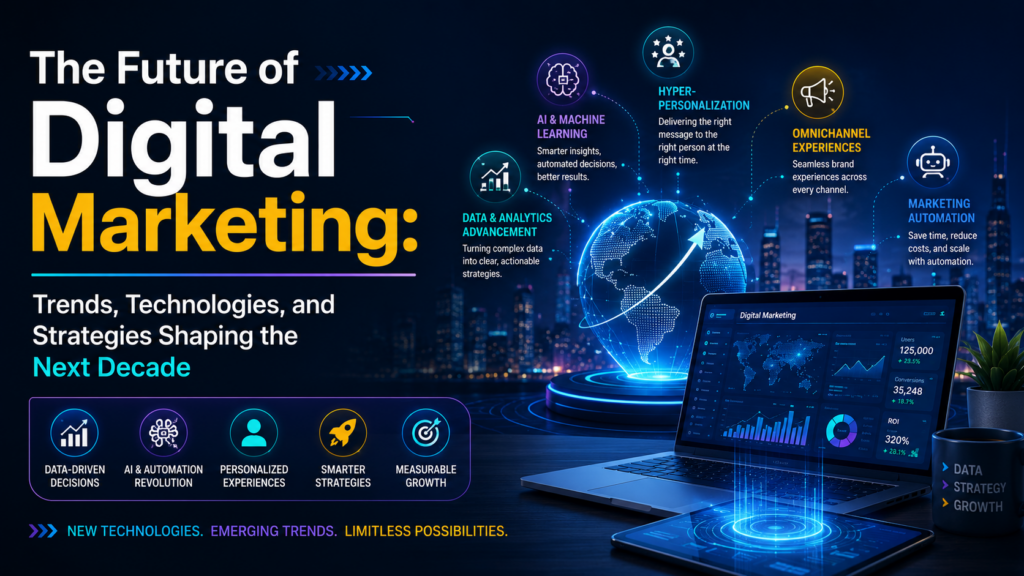
Digital marketing has never stood still, but the pace of change happening right now is unlike anything the industry has seen before. Artificial intelligence has moved from a novelty to the operating layer beneath nearly every campaign. Search behavior is fragmenting across AI chatbots, social platforms, and voice assistants. Consumers are more skeptical of polished advertising and more drawn to authenticity than ever before. For any business trying to plan its marketing strategy for the years ahead, understanding where the industry is headed isn’t optional it’s essential for survival.
This guide breaks down the most important shifts defining the future of digital marketing, why they matter, and how businesses of every size can prepare for them.
Table of Contents
- Why the Future of Digital Marketing Matters Now
- AI Is No Longer a Tool — It’s the Strategic Layer
- The Rise of Agentic AI in Marketing
- Search Is Fragmenting: SEO Meets AI Search Optimization (AEO/GEO)
- Hyper-Personalization at Scale
- Short-Form and Shoppable Video Dominance
- Social Commerce and the Creator Economy
- Privacy-First Marketing and the Death of Third-Party Cookies
- Marketing Mix Modeling and Cross-Channel Measurement
- Authenticity, Trust, and Human-Centered Content
- Augmented and Virtual Reality Experiences
- Voice Search and Conversational Interfaces
- Sustainability and Purpose-Driven Marketing
- How Businesses Can Prepare for the Future of Digital Marketing
- Final Thoughts
1. Why the Future of Digital Marketing Matters Now
Every few years, marketers declare that “everything is changing.” Most of the time, that’s an overstatement. This time, it isn’t. Three forces are converging simultaneously:
- Generative and agentic AI are reshaping how content is created, how campaigns are optimized, and how consumers discover products.
- Privacy regulations and the phase-out of third-party tracking are forcing brands to rebuild their data strategies from the ground up.
- Consumer trust in traditional advertising is declining, while trust in peer recommendations, creators, and authentic content is rising.
Together, these shifts mean that strategies which worked well even two or three years ago are quickly losing effectiveness. Businesses that adapt early will capture outsized market share; those that don’t risk becoming invisible in increasingly AI-mediated customer journeys.
2. AI Is No Longer a Tool – It’s the Strategic Layer
For years, AI in marketing meant chatbots and basic automation. That has changed fundamentally. Today, AI sits at the center of how campaigns are planned, executed, and optimized not just how they’re automated.
Marketing teams now use AI to:
- Analyze customer behavior in real time and adjust targeting instantly
- Generate and test dozens of content variations simultaneously
- Predict which creative, channel, and audience combinations will perform best before a campaign even launches
- Personalize messaging down to the individual level, not just the segment level
This shift is changing what it means to be a marketer. The most valuable skill is no longer just producing content or running campaigns it’s knowing how to direct AI systems, interpret the insights they produce, and make strategic decisions based on that data. Marketers who treat AI as a creative and strategic partner, rather than a simple automation tool, are pulling ahead of those who use it only to speed up repetitive tasks.
What this means for your business: Invest in AI-powered marketing tools now, but pair them with human oversight. The brands winning with AI aren’t the ones automating everything they’re the ones using AI to free up human creativity and judgment for higher-level strategy.
3. The Rise of Agentic AI in Marketing
The next evolution beyond generative AI is agentic AI autonomous systems capable of making multi-step decisions and executing complex workflows with minimal human intervention. Instead of simply generating a piece of ad copy when prompted, an AI agent might:
- Monitor campaign performance continuously
- Reallocate ad spend across channels in real time based on results
- Launch, pause, or adjust creative variations without waiting for manual approval
- Coordinate actions across multiple platforms simultaneously
This represents a meaningful shift in how marketing teams operate day to day. Interestingly, even as AI tools become more capable, most consumers remain hesitant to let AI agents make autonomous purchase decisions on their behalf. That means generative and agentic AI are currently more influential in the early stages of discovery and research than at the final point of purchase a nuance that matters for how brands structure their funnels.
What this means for your business: Agentic AI adoption should focus on operational efficiency (bid management, reporting, A/B testing at scale) rather than assuming AI will close the sale for you. Keep the human touch strong at the decision and conversion stage.
4. Search Is Fragmenting: SEO Meets AI Search Optimization (AEO/GEO)
Traditional SEO optimizing for the ten blue links on a Google results page is no longer the whole picture. Search behavior is fragmenting across:
- AI-powered chat and search assistants that summarize answers directly
- Social platforms increasingly used as discovery engines, especially among younger audiences
- Voice assistants and conversational interfaces
- Traditional search engines, which are still important but now often surface AI-generated overviews before organic links
This has given rise to new disciplines sometimes called Answer Engine Optimization (AEO) or Generative Engine Optimization (GEO) — the practice of structuring content so it’s more likely to be cited, summarized, or recommended by AI systems, not just ranked by traditional algorithms.
Practical implications for content strategy:
- Structure content clearly, with direct answers near the top, supported by detail below AI systems favor content that’s easy to extract and summarize.
- Build topical authority, not just individual keyword rankings. AI systems tend to trust and cite sources that demonstrate deep, consistent expertise on a subject.
- Earn mentions and citations elsewhere on the web. AI answer engines often synthesize information from multiple sources, so digital PR and third-party mentions matter more than ever.
- Don’t abandon traditional SEO fundamentals technical health, page speed, backlinks, and user experience remain foundational, even as the destinations for that traffic diversify.
What this means for your business: Treat search optimization as a multi-channel discipline. Optimize for Google, but also think about how your content would be summarized by an AI assistant and how discoverable your brand is within social platforms and creator content.
5. Hyper-Personalization at Scale
Personalization has been a marketing buzzword for years, but AI is finally making true one-to-one personalization achievable at scale. A large majority of consumers now say they’re more likely to buy from brands that deliver personalized content, and that expectation is only growing.
What’s changed is the granularity. Instead of segmenting audiences into broad personas, AI systems can now:
- Personalize product recommendations based on real-time browsing behavior
- Dynamically adjust email content, subject lines, and send times per individual recipient
- Tailor website experiences on the fly based on a visitor’s inferred intent
- Generate ad creative variations tuned to micro-segments rather than broad demographics
What this means for your business: Personalization is no longer a “nice to have” competitive edge — it’s becoming a baseline expectation. Businesses that still rely on generic, one-size-fits-all messaging will increasingly feel outdated to their audiences.
<a id=”video-dominance”></a>
6. Short-Form and Shoppable Video Dominance
Video especially short-form video continues to be one of the most powerful formats in digital marketing, and it’s evolving in a new direction: shoppable video. Rather than serving purely as a top-of-funnel brand awareness tool, video content is increasingly integrating the entire conversion funnel directly into the viewing experience.
Connected TV (CTV) platforms are also proving their effectiveness beyond national brand campaigns, extending into local and direct-response advertising. The distinction between “watching content” and “shopping” is blurring fast, particularly on streaming and social platforms where viewers can purchase a product without ever leaving the video.
What this means for your business: If your current video strategy stops at brand awareness, it’s time to think about how to shorten the path from view to purchase whether that’s shoppable tags, direct links in video descriptions, or integrated checkout experiences on the platforms where your audience already spends time.
7. Social Commerce and the Creator Economy
Discovery increasingly starts on social platforms rather than search engines. A significant share of consumers now say social content, peer recommendations, or online communities influence how they discover new brands with traditional search often used afterward simply to validate a decision already being made.
This has elevated the role of creators, who now function less like traditional influencers and more like trusted intermediaries between brands and audiences. Authentic, creator-led content tends to outperform polished brand advertising because it feels like a recommendation rather than a pitch.
What this means for your business: Creator partnerships shouldn’t be treated as a one-off campaign tactic. The most effective brands are building ongoing relationships with creators who genuinely align with their values and audience, treating them as an extension of the marketing team rather than a paid placement.
8. Privacy-First Marketing and the Death of Third-Party Cookies
Privacy regulation and platform-level changes have permanently altered how marketers collect and use data. Third-party cookies are increasingly unreliable or unavailable, and consumers are more aware of and concerned about how their data is used.
This is pushing marketers toward:
- First-party data strategies collecting data directly from customers through owned channels like email, loyalty programs, and websites
- Zero-party data information customers proactively share (preferences, quiz answers, survey responses) in exchange for a better experience
- Contextual targeting, which places ads based on the content being viewed rather than tracking individual users across the web
- Privacy-native measurement tools that estimate performance without relying on granular individual tracking
What this means for your business: If your marketing strategy still depends heavily on third-party tracking and retargeting, now is the time to build a first-party data foundation — through email lists, loyalty programs, gated content, and direct customer relationships — before that dependency becomes a liability.
<a id=”mmm”></a>
9. Marketing Mix Modeling and Cross-Channel Measurement
As ad channels and data sources fragment, measuring the full customer journey has become significantly harder. This has driven renewed investment in Marketing Mix Modeling (MMM) a statistical approach to measuring the aggregate impact of marketing across channels, rather than relying solely on last-click attribution.
AI is accelerating this shift by making it possible to process far larger, messier datasets and surface insights faster than traditional MMM approaches ever could.
What this means for your business: Don’t rely on a single attribution model to make budget decisions. A blended approach combining platform-level analytics, first-party data, and broader mix modeling gives a far more accurate picture of what’s actually driving results.
10. Authenticity, Trust, and Human-Centered Content
Ironically, as AI-generated content becomes more prevalent, authenticity has become more valuable, not less. The proliferation of AI-generated and synthetic content online has made audiences more skeptical, and more selective about which brands and voices they trust.
This is fueling a shift toward:
- Human-centered storytelling that feels genuine rather than manufactured
- Behind-the-scenes and unpolished content that signals authenticity
- Transparent communication about how and where AI is used in a brand’s operations
- A renewed premium on original research, first-hand expertise, and real customer stories
What this means for your business: Use AI to scale production, but don’t let it strip the human voice out of your brand. The businesses that will win trust in the coming years are the ones that use AI as a tool in
11. Augmented and Virtual Reality Experiences
AR and VR continue to mature as tools for bridging digital content with real-world engagement. Rather than being a novelty, immersive experiences are increasingly used for practical purposes virtual try-ons, interactive product demonstrations, and immersive brand experiences that let customers engage with products before purchasing.
What this means for your business: AR/VR investment doesn’t need to be elaborate to be effective. Even simple applications like a virtual try-on feature or an interactive 3D product view can meaningfully reduce purchase hesitation and improve conversion rates, particularly for e-commerce.
12. Voice Search and Conversational Interfaces
Voice search and conversational AI assistants continue to change how people look for information, particularly for local and transactional queries. As conversational interfaces become more capable, optimizing for natural, question-based language rather than short keyword phrases is becoming increasingly important.
What this means for your business: Structure content to answer natural-language questions directly and conversationally, and make sure local business information (hours, location, services) is accurate and consistently listed, since voice queries frequently skew local and intent-driven.
13. Sustainability and Purpose-Driven Marketing
Consumers, particularly younger generations, increasingly factor a brand’s values, sustainability practices, and social impact into their purchasing decisions. This isn’t a passing trend it’s becoming a baseline expectation, especially as economic pressures make consumers more selective about which brands they choose to support.
What this means for your business: Purpose-driven marketing only works when it’s genuine. Overstated or vague sustainability claims are increasingly scrutinized and can damage trust faster than they build it. If your brand has a real story to tell here, tell it clearly and back it with evidence.
14. How Businesses Can Prepare for the Future of Digital Marketing
Given everything above, here’s a practical checklist for future-proofing your marketing strategy:
- Build a first-party data foundation. Don’t wait for third-party tracking to fully disappear start collecting and activating your own customer data now.
- Adopt AI as a strategic partner, not just an automation tool. Use it to generate insights and options, but keep human judgment in the loop for final decisions.
- Optimize for AI-driven discovery, not just traditional search. Structure your content to be clear, authoritative, and easy for AI systems to summarize and cite.
- Invest in short-form and shoppable video. Meet your audience where they already spend their attention, and shorten the path from discovery to purchase.
- Develop real creator relationships. Treat creator partnerships as long-term collaborations rather than transactional placements.
- Diversify your measurement approach. Combine platform analytics, first-party data, and broader mix modeling instead of relying on any single attribution model.
- Protect your brand’s authentic voice. Use AI to scale, but never let it replace the genuine human perspective that builds trust.
- Stay flexible. The pace of change in digital marketing shows no signs of slowing build a team and a strategy that can adapt quickly rather than one locked into a single playbook.
15. Final Thoughts
The future of digital marketing isn’t defined by a single technology or trend it’s defined by the convergence of several: AI moving from tool to strategic layer, search fragmenting across new discovery channels, privacy reshaping how data is collected and used, and consumers demanding more authenticity even as content production becomes more automated.
Businesses that treat these shifts as isolated tactics to bolt onto their existing strategy will struggle to keep pace. The ones that succeed will be those that rethink their marketing strategy holistically building first-party data relationships, embracing AI as a genuine strategic partner, and never losing sight of the human trust that ultimately drives every purchasing decision.
The brands that start adapting today won’t just keep up with the future of digital marketing they’ll help define it.