
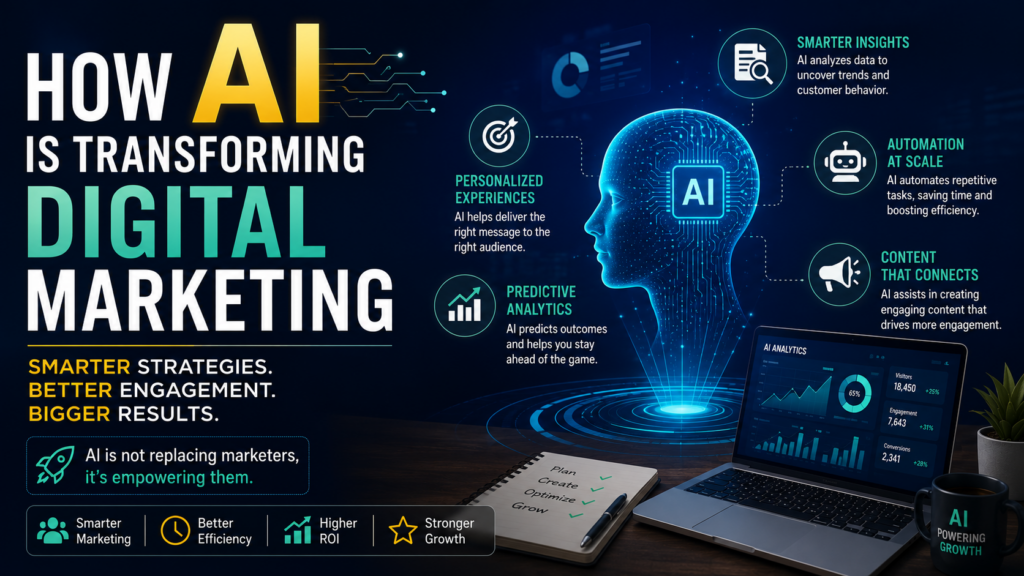
Artificial intelligence has moved from a buzzword to the backbone of modern marketing. What used to take analysts weeks to figure out audience segments, content performance, ad bidding strategies, customer intent AI now handles in real time, often more accurately than any human team could. If your marketing strategy isn’t leaning on AI yet, you’re likely leaving performance, budget, and growth on the table.
Marketing has always been about understanding people: what they want, when they want it, and how to reach them at the right moment. AI simply does this at a scale and speed no human team can match, processing millions of data points from browsing behavior, purchase history, social interactions, and search queries to uncover patterns that inform smarter decisions. The shift isn’t just automation it’s precision. Campaigns are no longer built on guesswork; they’re built on data-backed predictions.
Below is a detailed look at where AI is reshaping digital marketing today, and how to think about applying it to your own strategy.
Smarter, Faster Content Creation
Content is still king, but AI is changing how it gets made, tested, and refined.
Content generation. AI tools can draft blog posts, ad copy, product descriptions, and social captions in minutes, giving marketers a head start instead of a blank page. This doesn’t mean publishing raw AI output it means compressing the first-draft stage from hours to minutes so writers can spend their time on editing, fact-checking, and adding a genuine point of view.
Content optimization. AI tools analyze top-ranking content for a given keyword and suggest structure, length, and subtopics that align with what search engines and readers actually want. Instead of guessing what to include in an article, marketers can see exactly which questions competitors are answering and which ones they’re missing.
A/B testing at scale. Traditional A/B testing might compare two headlines. AI can simultaneously test dozens of variations of headlines, images, or calls-to-action across different audience segments, and automatically shift traffic toward whichever performs best often within hours instead of weeks.
Repurposing content. AI can take a single long-form article and generate social posts, email snippets, and short video scripts from it, stretching the value of every piece of content across multiple channels without multiplying the workload.
The key isn’t replacing human creativity it’s removing the repetitive, time-consuming parts of content production so marketers can focus on strategy, originality, and storytelling.
Hyper-Personalization at Scale
Generic marketing messages no longer cut it. Consumers expect experiences tailored to their specific interests, and AI makes this possible without manually segmenting every audience.
Dynamic website content changes based on a visitor’s behavior, location, or past interactions a returning visitor might see different homepage content than a first-time one, without anyone manually configuring it.
Personalized product recommendations are the engine behind “customers also bought” and similar features that drive a significant share of repeat purchases for e-commerce brands.
Behavioral triggers send the right message at the right time for example, a cart abandonment email sent within the specific window that’s statistically most likely to bring that particular customer back, rather than a fixed 24-hour delay applied to everyone.
Lifecycle personalization adjusts messaging based on where a customer sits in their journey a first-time buyer gets onboarding content, while a loyal repeat customer gets loyalty or upsell messaging.
This level of personalization used to require large teams manually building and maintaining segments. Now, AI platforms handle it continuously, learning and adjusting with every customer interaction.
Predictive Analytics and Customer Insights
One of AI’s biggest strengths is forecasting. Predictive analytics tools can:
- Identify which leads are most likely to convert, helping sales and marketing teams prioritize their time effectively
- Forecast customer lifetime value before a purchase even happens, informing how much it’s worth spending to acquire a given customer
- Flag customers at risk of churning so retention campaigns can kick in before it’s too late
- Predict trending topics, products, or search queries before they peak, giving brands a first-mover advantage
- Model “what-if” scenarios for pricing, promotions, or campaign timing before real budget is spent
This shifts marketing from a reactive function to a proactive one. Teams aren’t just responding to what happened last month they’re preparing for what’s statistically likely to happen next.
AI Is Reshaping SEO
Search engines themselves are increasingly AI-driven, which means SEO strategy has had to evolve alongside them.
Search intent matching. AI-powered search algorithms prioritize content that best matches the intent behind a query, not just keyword density. A page stuffed with a keyword but light on genuinely useful information will underperform a shorter, more relevant page.
AI-assisted keyword research. Modern tools surface semantic and related keywords, helping marketers build content clusters that comprehensively cover a topic rather than targeting isolated, disconnected keywords.
Content gap analysis. AI can compare your content against top-ranking competitors and highlight subtopics or questions you haven’t addressed often the fastest way to find quick-win ranking opportunities.
Technical SEO audits. AI crawls sites faster and more thoroughly than manual audits, catching issues like broken links, slow load times, duplicate content, or missing structured data that could be quietly hurting rankings.
AI Overviews and answer engines. As search results increasingly include AI-generated summaries, being the source cited within those summaries is becoming as important as ranking in the traditional blue links which again rewards clear, well-structured, genuinely authoritative content.
The overall lesson: ranking well today means writing genuinely helpful, well-organized content that fully satisfies what a searcher is looking for which is exactly what AI-driven search algorithms are designed to reward.
Conversational AI and Chatbots
AI chatbots have evolved far beyond scripted FAQ bots. Today’s conversational AI can:
- Handle complex customer service queries with natural, human-like responses instead of rigid decision trees
- Qualify leads by asking the right follow-up questions before handing them off to a sales rep, so reps spend time on warmer conversations
- Provide 24/7 support, improving customer satisfaction without increasing headcount
- Guide users through product selection, effectively acting as a virtual sales assistant on the website itself
This creates a smoother customer journey and captures leads and questions that would otherwise be lost outside business hours.
Programmatic Advertising and Smart Bidding
AI has fundamentally changed how digital ads are bought, targeted, and optimized.
Automated bidding adjusts ad spend in real time based on the likelihood of conversion for each impression, ensuring budget goes toward the highest-value opportunities rather than being spread evenly.
Audience targeting uses AI to identify look-alike audiences that share behaviors and characteristics with your best existing customers, expanding reach without diluting quality.
Creative optimization automatically tests and swaps ad images, headlines, and calls-to-action based on which combinations perform best for specific audience segments a level of granular testing that would be impractical to run manually.
Cross-channel budget allocation increasingly uses AI to shift spend between platforms (search, social, display) based on which channel is currently delivering the best return, rather than relying on a fixed budget split decided at the start of a campaign.
This means smaller marketing teams can now run highly sophisticated ad campaigns that previously required large agency resources and dedicated analysts.
AI-Driven Email Marketing
Email remains one of the highest-ROI marketing channels, and AI is making it even more effective.
- Send-time optimization determines the best time to email each individual subscriber based on their own past engagement patterns, rather than a single send time for the whole list.
- Subject line testing predicts which subject lines will get the highest open rates before a campaign even sends, based on patterns from past campaigns.
- Dynamic content blocks personalize sections of an email for different segments within a single campaign, so one email template can serve many audiences at once.
- Churn prediction flags disengaged subscribers so win-back campaigns can be triggered automatically before they unsubscribe or go permanently inactive.
Visual and Voice Search Optimization
As more searches happen through images and voice assistants, AI is helping marketers adapt to new discovery patterns.
Visual search allows AI to identify products or objects directly from images, which makes optimizing product images with proper alt text, filenames, and structured data increasingly important for discoverability.
Voice search queries tend to be longer and more conversational than typed searches (“what’s the best running shoe for flat feet” rather than “best running shoes flat feet”). Content optimized for natural language and question-based phrasing performs better in this context than content written purely around short keywords.
Challenges and Ethical Considerations
AI isn’t a silver bullet, and it comes with real challenges marketers need to navigate carefully.
Data privacy. Personalization relies on data collection, which means brands must be transparent about how customer data is used and stay compliant with regulations like GDPR or CCPA. Trust, once lost, is hard to rebuild.
Over-automation risk. Leaning too heavily on AI can strip the human touch from a brand’s voice. The strongest results tend to come from using AI to handle scale and repetition while people retain control over strategy, tone, and final creative decisions.
Bias in algorithms. AI models can inherit biases present in their training data, which can affect targeting fairness or exclude certain audiences if left unchecked. Regular auditing of targeting outcomes matters.
Authenticity concerns. Audiences are increasingly able to spot generic, AI-generated content. Quality control, fact-checking, and a genuine brand voice still matter enormously AI should accelerate content production, not replace judgment.
How to Start Integrating AI Into Your Strategy
If you’re just beginning to bring AI into your marketing stack, start small and build from there rather than trying to overhaul everything at once.
- Audit your current tools. Many platforms you already use your CRM, email service, or analytics suite likely have AI features built in that are going unused.
- Start with one use case. Pick something specific, like AI-assisted content drafting or predictive email send times, before scaling to a full AI stack.
- Keep humans in the loop. Use AI to draft, analyze, and suggest but let your team make the final strategic and creative calls.
- Measure everything. Track how AI-driven changes affect conversion rates, engagement, and ROI so you can justify further investment with real numbers.
- Stay updated. AI marketing tools evolve quickly, so it’s worth revisiting your stack every few months to see what’s newly possible.
Where This Is Heading
Looking ahead, AI is expected to move even deeper into marketing operations from more autonomous campaign management to highly personalized content generated dynamically for individual customers. Search engines will continue to favor genuinely useful, well-structured content over keyword-stuffed pages, and brands that combine AI’s efficiency with authentic human storytelling will have the strongest competitive edge.
The brands that win in this next phase of digital marketing won’t be the ones that use AI the most they’ll be the ones that use it the smartest, blending automation with genuine creativity and real customer understanding.
Final Thoughts
AI isn’t replacing marketers it’s amplifying what good marketers can already do. From content creation and SEO to advertising, email, and customer retention, AI is helping brands make faster, smarter, and more personalized decisions across every touchpoint. The businesses that adapt now will be the ones setting the pace in the years ahead.